
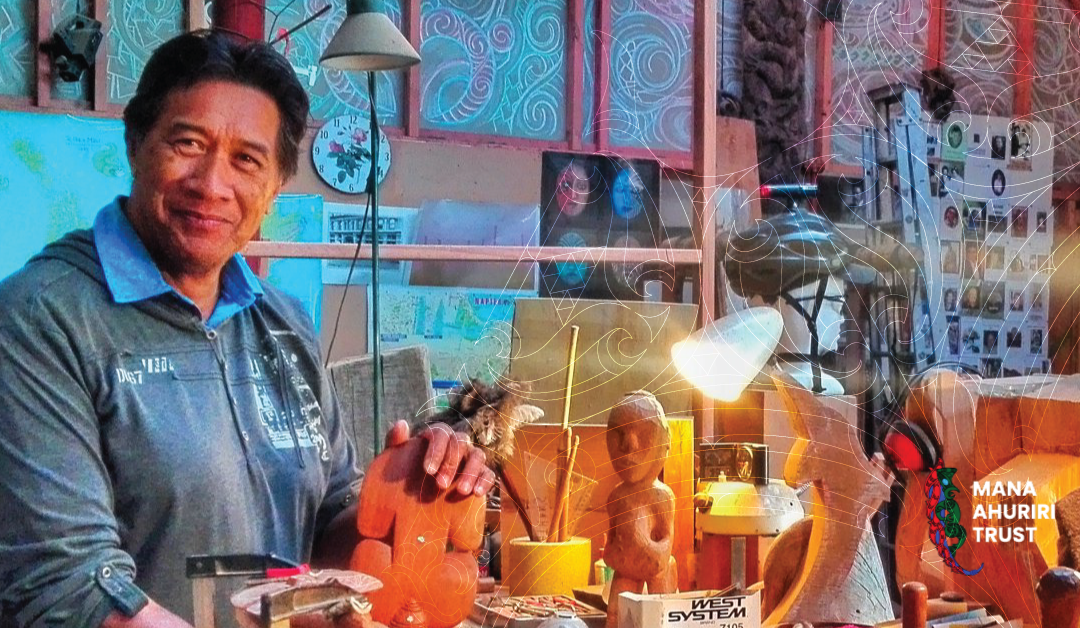
Six significant pou created by the late master carver Hugh Tareha have been restored by local Toi Māori practitioner Nathan Foote, marking a poignant moment in Hawke’s Bay’s cultural landscape. These pou, crafted from what Tareha affectionately called “Canadian kauri” – believed to be cedar – represent some of the final works by the renowned Māori artist who passed away suddenly in May 2022 at the age of 63.
The timber used for these pou has an interesting journey of its own. The wood originally traveled from North America as support beams for machinery ordered by PanPac, who later gifted the materials to Tareha for his artistic work. After completion of the restoration work, these pou are now ready for reinstallation at their designated sites.
Hugh Tareha, born around 1961 and a descendant of paramount Ahuriri chief Tareha Te Moananui, began his carving journey in the 1980s. As a member of the Ngāti Parau iwi, he became known for his ability to blend spiritual concepts with physical form in his artwork. His impressive portfolio includes numerous works that have become landmarks across Hawke’s Bay, including distinctive figures carved from tree stumps beside State Highway 50 at Waiohiki golf course, where he was based as a resident artist at Waiohiki Creative Arts Village.
Throughout his career, Tareha created works that captured the attention of both locals and international visitors, including legendary American rock guitarist Joe Walsh of The Eagles. Despite his renowned status, Tareha was known for his humble nature. As his brother-in-law Denis O’Reilly poetically described him, “He had the calloused hands of a carver, and diamonds on the soles of his shoes.”
A Legacy at Ahuriri Estuary
Tareha’s connection to Te Whanganui-a-Orotū (Ahuriri Estuary) runs deep through his artistic and cultural work. For over 20 years, several pou originally carved by Tareha and installed in partnership with the Department of Conservation have stood sentinel around the estuary. However, the harsh estuarine environment has taken its toll on these guardians, leading to a proposal for their replacement.
Before his passing, Tareha, along with kaumātua of Ngāti Pārau Hapū, had been working with the Department of Conservation to create six replacement pou. These new works were to be based on the traditional moteatea composed by Tamatea Pokaiwhenua and Kahungunu, specifically “Te Pepeha o Tamatea Pokaiwhenua,” which celebrates the abundant and diverse foods that flourished in and around the Ahuriri estuary in the 1400s.
The proposed six pou represented the traditional foods mentioned in the ancient chant:
- Karoro (Sea Gull)
- Patiki (Flounder)
- Pāua (Pāua)
- Pūpū (Cats eye)
- Kiore (Rat)
- Aruhe (Fern Root)
This concept reflected Tareha’s deep understanding that Te Whanganui-a-Orotū was traditionally known as the food basket of the region, celebrated for its abundance and variety of sustenance.
The Restoration Project
The restoration work was undertaken by Nathan Foote, a master carver in his own right, who brings 20 years of experience to the project. Foote, trained at the prestigious New Zealand Māori Arts and Crafts Institute in Rotorua, has created notable works including pou at Atea a Rangi and Frimley School, as well as contributions to Te Whare Te Manukura at Taikura Rudolf Steiner.
These pou hold particular significance as they are among the last works completed by Tareha before his unexpected passing, which occurred shortly after a salsa practice in Napier. Their installation will serve as a lasting testament to Tareha’s legacy, joining his other celebrated works that include sculptures at Ahuriri Estuary and West Quay, installations at the EIT Otatara campus, carvings at Waiohiki and Pukemokimoki marae, and the distinctive waharoa at Napier Port’s kororā sanctuary.
The completion of these pou by Foote ensures that Tareha’s vision for honouring the cultural and ecological heritage of Te Whanganui-a-Orotū will continue to educate and inspire future generations, while his artistic legacy remains deeply embedded in the landscape he knew and loved so well.
Installation Sites
The six restored pou will be installed at two significant locations around the Ahuriri Estuary, with three pou at each site. The Humber Street site, which receives the most visitor traffic, will feature:
- Te Karoro tangi tararau mai I runga o Tapu Te Ranga (Sea Gull) – The tallest pou positioned at the back
- Te Patiki tahanui o Otiere e (Flounder) – The middle-sized pou positioned slightly forward
- Te Paua patoto mai I runga o Tuhinga (Pāua) – The smallest pou at the front
The West Quay site will house the remaining three pou:
- Te Pupu tangi mai I runga o Matakarohirohi (Cats eye) – The tallest
- Te Kiore pekenui o Rimariki (Rat) – The middle-sized
- Te aruhe maomaonui o Pukekohu (Fern Root) – The smallest
This thoughtful arrangement ensures that the ancient moteatea of Tamatea Pokaiwhenua and Kahungunu continues to tell its story of abundance and cultural heritage to all who visit these sacred sites along Te Whanganui-a-Orotū.